

Pay in installments of $6.99 with
 ,
,
 and
and

Shipping Estimate
USA
- USA
- CAN
- USA
- CAN
Ships within 48 hours · Estimated delivery Jun 29 - Jul 4
 Promo Codes Available:
For Your Every Summer RSVP, with Code: SUMMER15
Description
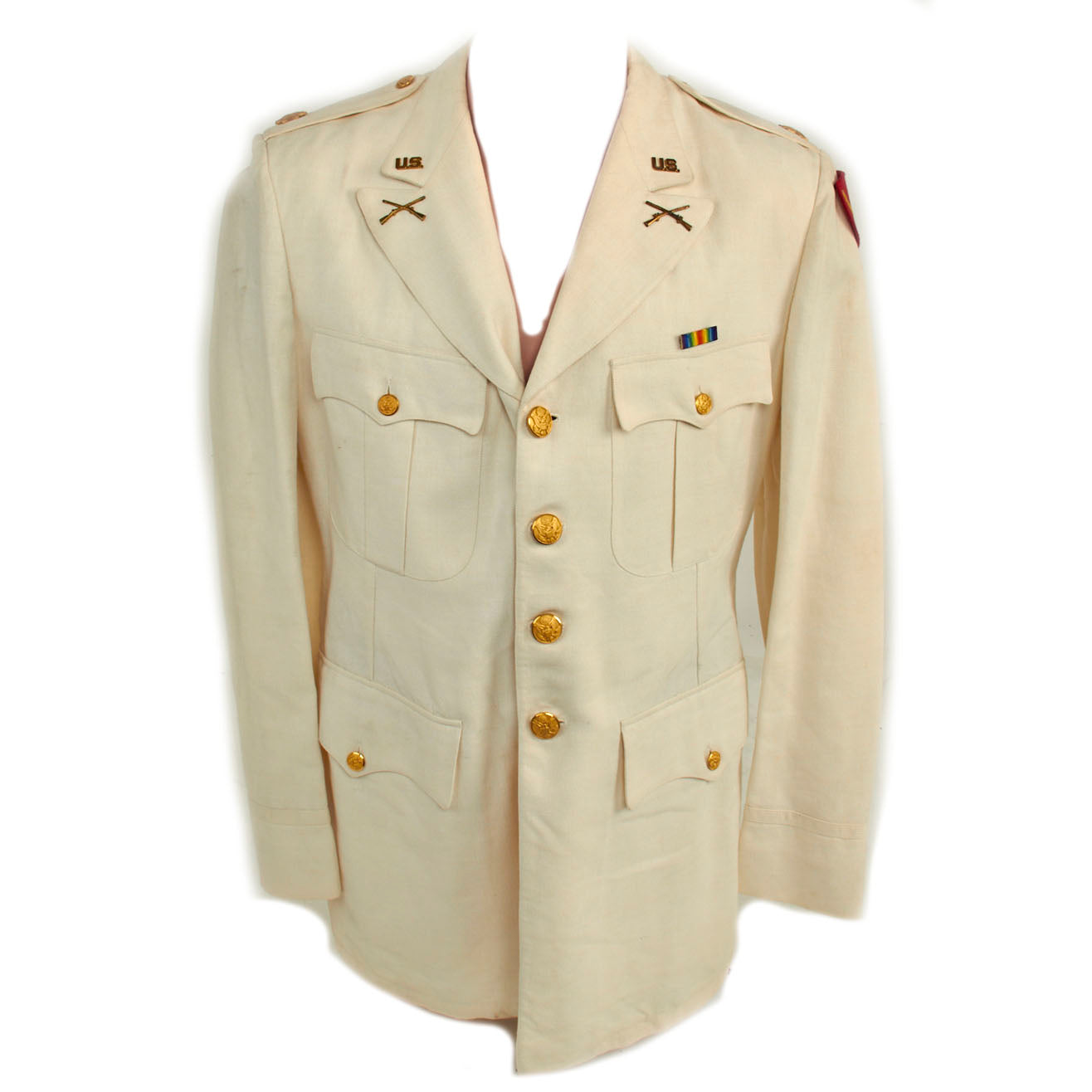
military dress white uniform Original U.S. Early WWII US Army Major's Philippine Division Tropical – International Military AntiquesOriginal Item: Only One Available. Dress whites weren't just for the Navy for much of U. S. military history. Both the Air Force and the Army sported nifty dress whites, as did the Marine Corps. The uniforms weren't just for formal ceremonies, either. They were worn as an everyday uniform for troops in tropical climates, such as, in this case, the Philippines. Air Force Chief of Staff Merrill McPeak did away with the Air Force whites in the early
Original Item: Only One Available. Dress whites weren't just for the Navy for much of U.S. military history. Both the Air Force and the Army sported nifty dress whites, as did the Marine Corps. The uniforms weren't just for formal ceremonies, either. They were worn as an everyday uniform for troops in tropical climates, such as, in this case, the Philippines.
Air Force Chief of Staff Merrill McPeak did away with the Air Force whites in the early 1990s, and the Marine Corps whites were phased out by 2000. The Army held on a little bit longer, doing away with the uniform in 2007.
This wonderful early WWII Dress White jacket belonged to a Major in the US Army’s Philippine Division. This Major, who remains unidentified due to only having a laundry number (8290A), could very well have been a victim of the atrocities committed by the Japanese after the unit’s surrender.
Units of the Philippine Division were on security missions at Manila, Fort McKinley, and Bataan prior to the declaration of war in the Pacific, 8 December 1941. After undergoing 2 days of bombings, the Division moved into the field to cover the withdrawal of troops to Bataan and to resist the enemy inthe Subic Bay area. From 11 to 23 December, positions were organized and strengthened and on 23 December the Division was assigned to the Bataan Defense Forces. While the 31st Infantry moved to the vicinity of Zig-Zag to cover the flanks of troops withdrawing from central and southern Luzon, 30 December, the rest of the Division organized the main and reserve positions on Bataan. The 31st Infantry moved to a defensive position on the west side of the Olongapo Road near Layac Junction, 5 January 1942. This junction was lost on the 6th, but the withdrawal to Bataan had been successfully concluded.
The Division was placed in reserve from 7 to 14 January 1942. This period was largely one of reconnaissance and development by the Japanese in preparation for their attack on the main battle position on the Abucay line. Elements repulsed night attacks near Abucay, 10-12 January,, and other elements of the Division counterattacked on the 16th. Strong offensive and defensive action was not able to prevent enemy penetrations and the Division withdrew to the Reserve Battle Position in the Pilar-Bagac area, 2 January. Until the latter part of March the enemy, made cautious by heavy losses, engaged in patrols and limited local attacks, and after a general retirement, 24 February, did not undertake any serious activity on this front until 28 March. During this period elements of the Division were shifted to assist in the defense of other sectors. The enemy attack on 28 March struck at a division weakened by malnutrition, sickness, and prolonged exposure to combat.
The Division, no longer operating as a coordinated unit, was unable to counterattack against heavy enemy assaults. On 8 April, the 57th Infantry and the 31st Infantry were lost near the Alangan River, and the 45th Infantry surrendered, 10 April 1942. The victory over Japan ended the misery of Japanese prison camps for the survivors of the Philippine Division.
The overall condition of the uniform dress jacket is close to excellent. The white color is still very much the original color and has minimal age toning and virtually no stains present that we can find on the exterior. All buttons are present, each shoulder has a lovely bronze Oak Leaf for the rank of Major, there is a single WWI Victory Medal Ribbon located on the left front, meaning he could have been a veteran of the Great War or this was just an addition to the uniform.
The left shoulder features a lovely button on shoulder sleeve insignia. The insignia consists of a gold caboshed carabao’s head on a scarlet spade-shaped shield. The carabao is suggestive of the Philippines, and the colors red and gold represent the Spanish heritage of the islands.
This is an excellent opportunity to pick up a fantastic and rather rare US Army Tropical Dress Uniform! Comes more than ready for further research and display.
Approximate Measurements:
Collar to shoulder: 10”
Shoulder to sleeve: 26.5”
Shoulder to shoulder: 17”
Chest width: 20.5”
Waist width: 18”
Hip width: 22”
Front length: 34.5"
Shipping Notes
- Free Standard Shipping on $100+ Orders to the USA.
- Except Preorder products are shipped in 48 hours.
- Delivery to the USA:
- Standard Shipping : 3-10 business days
- If time is of the essence, please consider selecting expedited delivery for faster service.
Exchange/Return Notes
- We offer a 30-day return/exchange service after receiving.
- Final sale items are not eligible for returns or exchanges.
- To process your return/exchange, please contact us at [email protected]
- Please click here for more details>>> Return & Exchange Policy